Sometimes we get stuck in this self-defeating mindset of “waiting around.” All we can think about is how we’re waiting for God to do this, waiting for God to do that… waiting, waiting, waiting… poor pitiful us.
I certainly don’t think waiting is always a bad thing. In fact, I would call it a skill, even a discipline. But it is only such when our hearts are expectant of God’s move. Wait in misery, and we find ourselves doubting that God will ever show his face. But wait in faith, and there is hope. I’m a firm believer in the concept “You can’t walk in hope if you’re thinking in defeat.”
When I read Isaiah 30:18 today, I realized we’re not the only ones waiting… God waits too.
God's not finished. He's waiting around to be gracious to you. He's gathering strength to show mercy to you. God takes the time to do everything right—everything. Those who wait around for him are the lucky ones. (The Message)
God is not afraid of waiting. He’s not afraid to take his time. And he is certainly ok with waiting on us if it means we will eventually see his face.
What good news. He was waiting on me long before I was ever waiting on Him. If I’m worth waiting on, so is He.
Showing posts with label Biblical Reflection. Show all posts
Showing posts with label Biblical Reflection. Show all posts
Thursday, March 22, 2007


Saturday, November 25, 2006
Unload the Camel
In the last couple of days, I have come into a new appreciation for the story of the Rich Young Man (found in Matthew 19, Mark 10, and Luke 18). Many of us who are familiar with this story have often heard it equated to a love for money and sacrifice for the Kingdom of God—which I am not denying. But, as I read it a few days ago for probably the 100th time, I gathered something else from the words of Jesus to this curious man.
The man wanted to know what he must do to inherit an eternity with God. Apparently, he was a man who obeyed the Law and also possessed great wealth. This is important to the story because riches in that day were thought to be an indicator of God’s favor. Wealth was said to be an index of a person’s spiritual state. Therefore, the man had probably until this time bore his wealth quite proudly as an assurance of his salvation. And then came the unexpected announcement of Christ: Sell it. It’s worthless. It’s not what I’m looking for.
In fact, Jesus went so far as to say that a camel could more easily pass through the eye of a needle than for a rich man to enter his Kingdom.
 There is much debate about this analogy, but I find it quite interesting that the “Eye of the Needle” was also a phrase used to describe a small entrance in large gates for passengers on foot. The large gates were opened only for pack-bearing animals (i.e. camels carrying a large load). For one of these animals to even have a hope of fitting through this small, single-person entrance, it would have to remove all of its packs.
The Rich Young Man had loaded his life with his own idea of “spiritual indicators.” He was like a camel, bearing his hefty load with pride. Much like him, we often stack our backs high with good deeds, the “right” words, and dutiful devotion times—packing for our self-navigated trip into the Kingdom of Heaven. We compose man-made indications of our spiritual relationship to God, and we follow them like a script. We put on our suits and ties and our best Sunday dress, we set our timer and pray until it dings, memorize our bible verses, and promise to save one more soul. With our checklist, we dutifully pack our bags for eternity.
And then God says, “Unload the camel.”
It’s not the way in. The loads we attempt to bear are often endured in vain, and to get through the eye of that needle, we have to let it all go.
I am not discounting the relevance of spiritual discipline, nor the importance of intentional sacrifice for the Kingdom. But I have to wonder at times if we have mistaken these things as a means to an end. When we unpack our camels, what is left? What are we without the things we do? To be more clear, what is in our hearts? What is our heart’s attitude towards God? What is our heart's attitude towards the ones we love... and even those we don't?
Do we love from the deepest corners of our heart... or do we spend our time looking for more self-serving novelties to pack away in the luggage of our soul?
God has really challenged me to unload my camel and examine my heart underneath. More than anything else, I want my heart to be pure before Him. And even if it means stripping my devotion to everything else, I want to be able to fit through that door.
If I speak in the tongues of men and of angels, but have not love, I am only a resounding gong or a clanging cymbal. If I have the gift of prophecy and can fathom all mysteries and all knowledge, and if I have a faith that can move mountains, but have not love, I am nothing. If I give all I possess to the poor and surrender my body to the flames, but have not love, I gain nothing. (1 Corinthians 13:1-3)
The man wanted to know what he must do to inherit an eternity with God. Apparently, he was a man who obeyed the Law and also possessed great wealth. This is important to the story because riches in that day were thought to be an indicator of God’s favor. Wealth was said to be an index of a person’s spiritual state. Therefore, the man had probably until this time bore his wealth quite proudly as an assurance of his salvation. And then came the unexpected announcement of Christ: Sell it. It’s worthless. It’s not what I’m looking for.
In fact, Jesus went so far as to say that a camel could more easily pass through the eye of a needle than for a rich man to enter his Kingdom.
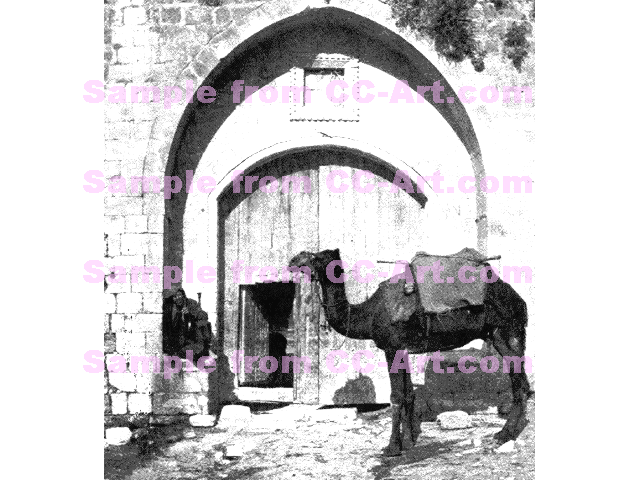 There is much debate about this analogy, but I find it quite interesting that the “Eye of the Needle” was also a phrase used to describe a small entrance in large gates for passengers on foot. The large gates were opened only for pack-bearing animals (i.e. camels carrying a large load). For one of these animals to even have a hope of fitting through this small, single-person entrance, it would have to remove all of its packs.
The Rich Young Man had loaded his life with his own idea of “spiritual indicators.” He was like a camel, bearing his hefty load with pride. Much like him, we often stack our backs high with good deeds, the “right” words, and dutiful devotion times—packing for our self-navigated trip into the Kingdom of Heaven. We compose man-made indications of our spiritual relationship to God, and we follow them like a script. We put on our suits and ties and our best Sunday dress, we set our timer and pray until it dings, memorize our bible verses, and promise to save one more soul. With our checklist, we dutifully pack our bags for eternity.
And then God says, “Unload the camel.”
It’s not the way in. The loads we attempt to bear are often endured in vain, and to get through the eye of that needle, we have to let it all go.
I am not discounting the relevance of spiritual discipline, nor the importance of intentional sacrifice for the Kingdom. But I have to wonder at times if we have mistaken these things as a means to an end. When we unpack our camels, what is left? What are we without the things we do? To be more clear, what is in our hearts? What is our heart’s attitude towards God? What is our heart's attitude towards the ones we love... and even those we don't?
Do we love from the deepest corners of our heart... or do we spend our time looking for more self-serving novelties to pack away in the luggage of our soul?
God has really challenged me to unload my camel and examine my heart underneath. More than anything else, I want my heart to be pure before Him. And even if it means stripping my devotion to everything else, I want to be able to fit through that door.
If I speak in the tongues of men and of angels, but have not love, I am only a resounding gong or a clanging cymbal. If I have the gift of prophecy and can fathom all mysteries and all knowledge, and if I have a faith that can move mountains, but have not love, I am nothing. If I give all I possess to the poor and surrender my body to the flames, but have not love, I gain nothing. (1 Corinthians 13:1-3)
Tuesday, September 12, 2006
the power of one choice
When I found Israel, it was like finding grapes in the desert; when I saw your fathers, it was like seeing the early fruit on the fig tree. But when they came to Baal Peor, they consecrated themselves to that shameful idol and became as vile as the thing they loved. –Hosea 9:10
I stumbled upon this verse just over a year ago in the aftermath of a wave of destruction in my life. It really made me think about the power our choices have on the rest of our lives. As my eyes were being unveiled to the nature of deceit and manipulation I had fallen prey to, I was startled to realize that it all began with one choice. That’s all. It took one decision against my better judgment, and in the time frame of one year, my life was nearly destroyed. My sensitivity to the Holy Spirit had dwindled and my passion for ministry was barely visible through the fog of self-betrayal.
It pains me to think about what that one choice did to the heart of God… I imagine it was something like what we read in the above verse. I think God was full of grief to see the children of Israel—whom he had set apart, who were such a source of refreshment to his heart—take on the very nature of the thing they chased after. “Vile.” What a dramatic change from being an image of the glory of God, the one(s) to reveal Him to the nations.
And yet, in the messes we make, there is grace.
Like water spilled on the ground, which cannot be recovered, so we must die. But God does not take away life; instead, he devises ways so that a banished person may not remain estranged from him. –2 Samuel 14:14
It really is that simple. It is a beautiful thing to step into an understanding of the incredible mercy that flows from the heart of God… He always seeks to restore us back to Himself.
I stumbled upon this verse just over a year ago in the aftermath of a wave of destruction in my life. It really made me think about the power our choices have on the rest of our lives. As my eyes were being unveiled to the nature of deceit and manipulation I had fallen prey to, I was startled to realize that it all began with one choice. That’s all. It took one decision against my better judgment, and in the time frame of one year, my life was nearly destroyed. My sensitivity to the Holy Spirit had dwindled and my passion for ministry was barely visible through the fog of self-betrayal.
It pains me to think about what that one choice did to the heart of God… I imagine it was something like what we read in the above verse. I think God was full of grief to see the children of Israel—whom he had set apart, who were such a source of refreshment to his heart—take on the very nature of the thing they chased after. “Vile.” What a dramatic change from being an image of the glory of God, the one(s) to reveal Him to the nations.
And yet, in the messes we make, there is grace.
Like water spilled on the ground, which cannot be recovered, so we must die. But God does not take away life; instead, he devises ways so that a banished person may not remain estranged from him. –2 Samuel 14:14
It really is that simple. It is a beautiful thing to step into an understanding of the incredible mercy that flows from the heart of God… He always seeks to restore us back to Himself.
Thursday, August 31, 2006
to be near God
“But as for me, it is good to be near God. I have made the Sovereign Lord my refuge; I will tell of all your deeds.” (Psalm 73:28)
It can be daunting to think of all of the unknowns life possesses. Realizing that the line between contentment and eagerness is faint, I often wonder which side of the line I am on. Perhaps I have a foot planted on either side. The thought struck me today that maybe the two aren’t mutually exclusive. Can I be content with where I am today, and still possess an eagerness for what I will do tomorrow? Is it possible for us to rest in quiet confidence that today we are near God, and that is the goal of our salvation… and yet operate in eager preparation for encounters with the lives we have yet to touch?
Perhaps contentment is not a state of being still, as it is often portrayed. What if it is a dynamic, yet peaceful way of functioning, of thinking, of preparing our hearts for what is ahead? My experiences have shown me that movement birthed out of contentment seems to bear fruit that is much stronger than movement birthed from restlessness.
What if, for right now, it really was good enough to be near God, to make God our refuge? The fruit of our lives may be that much more nurturing to hearts that need to be fed.
It can be daunting to think of all of the unknowns life possesses. Realizing that the line between contentment and eagerness is faint, I often wonder which side of the line I am on. Perhaps I have a foot planted on either side. The thought struck me today that maybe the two aren’t mutually exclusive. Can I be content with where I am today, and still possess an eagerness for what I will do tomorrow? Is it possible for us to rest in quiet confidence that today we are near God, and that is the goal of our salvation… and yet operate in eager preparation for encounters with the lives we have yet to touch?
Perhaps contentment is not a state of being still, as it is often portrayed. What if it is a dynamic, yet peaceful way of functioning, of thinking, of preparing our hearts for what is ahead? My experiences have shown me that movement birthed out of contentment seems to bear fruit that is much stronger than movement birthed from restlessness.
What if, for right now, it really was good enough to be near God, to make God our refuge? The fruit of our lives may be that much more nurturing to hearts that need to be fed.
Sunday, May 21, 2006
the muddy water that cleanses
I was reading an interesting passage of scripture today... 2 Kings 5. It taught me a lot about myself.
Naaman, commander of the army of Aram, had leprosy. He had gotten his king to send him to Israel (Aram's enemy) in order to be healed by the prophet Elisha. Upon his arrival in Israel, Naaman received the order from Elisha's messenger that he would need to go and dip in the Jordan river in order to receive the healing. Naaman got a little upset. That's where he started to remind me of myself...
v. 11-12 read "But Naaman went away angry and said, "I thought that he would surely come out to me and stand and call on the name of the Lord his God, wave his hand over the spot and cure me of my leprosy. Are not Abana and Pharpar, the rivers of Damascus, better than any of the waters of Israel? Couldn't I wash in them and be cleansed?" So he turned and went off in a rage."
I practically tripped over myself in that passage. The first thing that I recognized was Naaman's frustration that his move from God wasn't coming in the manner HE expected it to. "What?! All I get is a stinkin' messenger?! Isn't the prophet going to speak to me? Aren't I going to feel something? Isn't this going to be a big deal?"
Second, Naaman was bothered by being told to wash seven times in the Jordan. The Jordan, from what I understand, isn't exactly a pristine river. It's murky. It can be downright muddy. "Are you kidding? You want me to dip myself SEVEN times in this nasty water? How can something this disgusting possibly cleanse me?" I get the feeling that this wasn't the grandiose healing experience that Naaman was hoping for.
And so, here I sit--guilty as charged. I too have thrown fits like Naaman. I have ventured off on desperate journeys in search of an act of God, only to find that He doesn't move in exactly the way I had expected Him to. I couldn't even begin to count the number of times that I have expected God to turn a situation out a certain way, and not only does he NOT do it my way, but he also sends me to be cleansed in ways that aren't so pleasant at the time. And not only are they unpleasant, but sometimes it seems like what God asks me to do will take me in the opposite direction of where I'm trying to go!
There have been so many times that I have sought cleansing, and God has pointed me to muddy waters. How often do we expect our renewal to come as a nicely packaged, sweetly fragranced remedy for life, when in fact, what we need is a humble dipping in the mud of our own understanding. Ah, but yes... just as with Naaman in v. 14, obedience releases the grace of God for me to understand...
Somehow, every single time, it works. Every time, the muddy water that I try to avoid is exactly what carries me into the next sphere that God has for me. It washes away doubt, fear, pride, pain, and self-reliance, and it flushes me clean of my own expectations.
Naaman, commander of the army of Aram, had leprosy. He had gotten his king to send him to Israel (Aram's enemy) in order to be healed by the prophet Elisha. Upon his arrival in Israel, Naaman received the order from Elisha's messenger that he would need to go and dip in the Jordan river in order to receive the healing. Naaman got a little upset. That's where he started to remind me of myself...
v. 11-12 read "But Naaman went away angry and said, "I thought that he would surely come out to me and stand and call on the name of the Lord his God, wave his hand over the spot and cure me of my leprosy. Are not Abana and Pharpar, the rivers of Damascus, better than any of the waters of Israel? Couldn't I wash in them and be cleansed?" So he turned and went off in a rage."
I practically tripped over myself in that passage. The first thing that I recognized was Naaman's frustration that his move from God wasn't coming in the manner HE expected it to. "What?! All I get is a stinkin' messenger?! Isn't the prophet going to speak to me? Aren't I going to feel something? Isn't this going to be a big deal?"
Second, Naaman was bothered by being told to wash seven times in the Jordan. The Jordan, from what I understand, isn't exactly a pristine river. It's murky. It can be downright muddy. "Are you kidding? You want me to dip myself SEVEN times in this nasty water? How can something this disgusting possibly cleanse me?" I get the feeling that this wasn't the grandiose healing experience that Naaman was hoping for.
And so, here I sit--guilty as charged. I too have thrown fits like Naaman. I have ventured off on desperate journeys in search of an act of God, only to find that He doesn't move in exactly the way I had expected Him to. I couldn't even begin to count the number of times that I have expected God to turn a situation out a certain way, and not only does he NOT do it my way, but he also sends me to be cleansed in ways that aren't so pleasant at the time. And not only are they unpleasant, but sometimes it seems like what God asks me to do will take me in the opposite direction of where I'm trying to go!
There have been so many times that I have sought cleansing, and God has pointed me to muddy waters. How often do we expect our renewal to come as a nicely packaged, sweetly fragranced remedy for life, when in fact, what we need is a humble dipping in the mud of our own understanding. Ah, but yes... just as with Naaman in v. 14, obedience releases the grace of God for me to understand...
Somehow, every single time, it works. Every time, the muddy water that I try to avoid is exactly what carries me into the next sphere that God has for me. It washes away doubt, fear, pride, pain, and self-reliance, and it flushes me clean of my own expectations.
Subscribe to:
Posts (Atom)
